
For anyone interested in taking the next step and becoming a mitra, then check out this excellent online pamphlet explaining it:
http://issuu.com/thebuddhistcentre/docs/becoming_a_mitra_revised/1?e=0
If you have any questions, please ask Rob, Keith or Dhiyampati
Wednesday, 23 October 2013
Sunday, 25 August 2013
Neil's mitra ceremony is on 15th September
Many of you will know Neil who has been coming along for about 6 months now.
Just to let you know he is becoming a mitra in a ceremony at Cambridge Buddhist Centre on Padmasambhava Day http://www.cambridgebuddhistcentre.com/events/event_details.php?eid=3151 on Sunday 15th September.
That should be a good day (or afternoon, or evening) out, so if you have been thinking about visiting the Cambridge Centre, this would be a great time to go.
By the way, "mitra" just means "friend", and you can read an article about its significance here: http://www.cambridgebuddhistcentre.com/resources/files/MitraBookletWeb.pdf . If you are interested in knowing more, please ask myself, Rob or Dhiyampati.
Heartful congratulations to Neil for taking this step.
Keith
Just to let you know he is becoming a mitra in a ceremony at Cambridge Buddhist Centre on Padmasambhava Day http://www.cambridgebuddhistcentre.com/events/event_details.php?eid=3151 on Sunday 15th September.
That should be a good day (or afternoon, or evening) out, so if you have been thinking about visiting the Cambridge Centre, this would be a great time to go.
By the way, "mitra" just means "friend", and you can read an article about its significance here: http://www.cambridgebuddhistcentre.com/resources/files/MitraBookletWeb.pdf . If you are interested in knowing more, please ask myself, Rob or Dhiyampati.
Heartful congratulations to Neil for taking this step.
Keith
Sunday, 28 July 2013
New email address
To contact us, click on the contact tab at the top, and you can see our email addresses.
Saturday, 1 June 2013
BBC documentary about the life of the Buddha
For those that missed all or part of the film of the BBC documentary about the life of the Buddha, you can see it here on Youtube: https://www.youtube.com/watch?v=YsEksMEE2Eg
It is 50 minutes long.
It is part historic documentary, part re-enactment, and part analysis by experts. I don't think any of them were from Triratna, but they seemed very knowledgeable.
Like most BBC documentaries it gives a very objective and rational account of his life without any spin.
Highly recommended.
It is 50 minutes long.
It is part historic documentary, part re-enactment, and part analysis by experts. I don't think any of them were from Triratna, but they seemed very knowledgeable.
Like most BBC documentaries it gives a very objective and rational account of his life without any spin.
Highly recommended.
Wednesday, 10 April 2013
The 5 precepts
I am leading the class at Hertford on the 16th April.
After the meditation, we will begin a discussion on the 5 precepts that are gateways to happiness, joy, and lightness of being:
1) loving kindness,
2) open handed generosity,
3) stillness, simplicity and contentment
4) truthful communication
5) mindfulness clear and radiant
I hope to see you all there!
Keith
After the meditation, we will begin a discussion on the 5 precepts that are gateways to happiness, joy, and lightness of being:
1) loving kindness,
2) open handed generosity,
3) stillness, simplicity and contentment
4) truthful communication
5) mindfulness clear and radiant
I hope to see you all there!
Keith
Saturday, 23 March 2013
Why not like us on Facebook?
I have recently brought the Facebook page back to life
http://www.facebook.com/HertfordMeditation
It is very easy for me to update with articles, videos and photos. It is also very easy for people to like, share and comment on each post.
There is a reason Facebook has over a billion monthly active users. It must be doing something right!
I have just put a video up there about the mindfulness based approaches that the London Buddhist Centre are teaching for people suffering from depression and addiction.
I am also going to post a video on there about the importance of volunteering, and some videos with volunteers at the London Centre.
Don't worry! We haven't any need for volunteers at the Hertford group!
But I just think it is good for people to see what it is like at some of the other centres, so we know that we are all connected in some way to a much larger movement.
Anyway.
There are 20 people aleady who "like" the Facebook page.
If you could visit it, like the page, and maybe interact a bit with it (like, comment, or share), it would be much appreciated. That way we can stay connected to the energy of the group throughout the week.
thanks a lot
Keith
http://www.facebook.com/HertfordMeditation
It is very easy for me to update with articles, videos and photos. It is also very easy for people to like, share and comment on each post.
There is a reason Facebook has over a billion monthly active users. It must be doing something right!
I have just put a video up there about the mindfulness based approaches that the London Buddhist Centre are teaching for people suffering from depression and addiction.
I am also going to post a video on there about the importance of volunteering, and some videos with volunteers at the London Centre.
Don't worry! We haven't any need for volunteers at the Hertford group!
But I just think it is good for people to see what it is like at some of the other centres, so we know that we are all connected in some way to a much larger movement.
Anyway.
There are 20 people aleady who "like" the Facebook page.
If you could visit it, like the page, and maybe interact a bit with it (like, comment, or share), it would be much appreciated. That way we can stay connected to the energy of the group throughout the week.
thanks a lot
Keith
Wednesday, 13 March 2013
Why not visit our page at meetup.com
You may not be aware, but we have a page at meetup.com where we try and let people know what is going on.
Go to http://www.meetup.com/Hertford-Buddhist-Meditation/
It is totally free, and people often leave little comments about whether they are coming to the next meeting, or what they thought of the last one.
It just to helps build our spiritual community a bit, by giving people a chance to communicate with each other inbetween classes.
You can leave public messages, and also privately send emails to the other members of the group etc
There are a total of 19 people who have joined our meetup.com group at the moment.
Go to http://www.meetup.com/Hertford-Buddhist-Meditation/
It is totally free, and people often leave little comments about whether they are coming to the next meeting, or what they thought of the last one.
It just to helps build our spiritual community a bit, by giving people a chance to communicate with each other inbetween classes.
You can leave public messages, and also privately send emails to the other members of the group etc
There are a total of 19 people who have joined our meetup.com group at the moment.
Tuesday March 19th - discussion on ethics
On Tuesday March 19th, I will be leading the class, as Rob is going to visit the London Buddhist Centre.
As well as the normal meditations, I will be leading a discussion based around the chapter on ethics in Chris Pauling's book, "Introducing Buddhism".
For some people, the word "ethics" has negative or boring connotations. It is probably a bad translation of what we are talking about. A conscious code of behaviour in our everyday lives can be a gateway into a happy and joyous life.
The opening paragraph of this chapter states:
"Buddhism is a practical tradition. It does not just offer an inspiring vision of what a human being can become. It also provides a large number of effective techniques and practices to help us grow towards this ideal and make it a real force in our everyday lives"
Everyone is very welcome to come along.
Links to some articles about meditation
I am reposting some articles from our friends at the Hornchurch Buddhist Group that may be of interest:
Here is a link to a handout on Establishing a Regular Meditation Practice
This is a brief summary of the traditional categories of hindrances, the traditional similes for them and some suggestions for working with them. It is good to learn to begin to recognise the hindrances as and when they arise as this then puts one in a in a better position to counter them and move toward deeper absorption in meditation.
One traditional antidote that couldn’t be fitted fully on to on to the sheet is to “Go for Refuge”, which means essentially to call upon one’s confidence and faith in the ideal, the teachings and practices, and in one’s own potential and abilities. The Three Refuges are synonymous with the Three Jewels of Buddhism and are the Buddha, being the ideal of Enlightenment to which we aspire, his teaching and the path of practice known as the Dharma and the Buddhist community known as the Sangha. See also Saluting the Shrine and a Rough Guide to Buddhism.
Monday, 11 March 2013
2 order members are coming to lead it 12th March
We have just heard that 2 order members (Dridhakarin and Diyampati) are coming from Cambridge to lead the class tomorrow (on 12th March), so it should be a good night.
Tuesday, 19 February 2013
Parinirvana celebrations tonight
You are welcome to come to the Tuesday 19th February meditation class at the Millbridge room in Hertford for a celebration of the Buddhist festival of Parinirvana, the final passing away of the Buddha to complete and perfect Enlightenment.
There will be readings of stories from the last days of the Buddha, we will chant mantras and, of course practise meditation.
It'll be a different evening from the usual format, so see you on Tuesday,
There will be readings of stories from the last days of the Buddha, we will chant mantras and, of course practise meditation.
It'll be a different evening from the usual format, so see you on Tuesday,
Wednesday, 13 February 2013
Article about metta bhavana (loving kindness) meditation
I found this great article about the metta via my friends at the Hornchurch Buddhist Group http://hornchurchbuddhistgroup.org.uk/ .
The article is an excerpt from Kamalashila's book on meditation. Kamalashila is a very experienced and highly respected meditation teacher in Triratna.
Sitting barefoot under a tree is optional!
Metta Bhavana Meditation: Goodwill, Loving-kindness

brief description
Here’s a brief description of the stages of the Metta Bhavana practice to give an idea. Then follows a more detailed explanation. After that, we’ll discuss some related issues.
Prepare for the meditation. Sit quietly, settle down, connect with your body and with whatever you are feeling and thinking.
The article is an excerpt from Kamalashila's book on meditation. Kamalashila is a very experienced and highly respected meditation teacher in Triratna.
Sitting barefoot under a tree is optional!
Metta Bhavana Meditation: Goodwill, Loving-kindness
brief description
Here’s a brief description of the stages of the Metta Bhavana practice to give an idea. Then follows a more detailed explanation. After that, we’ll discuss some related issues.
Prepare for the meditation. Sit quietly, settle down, connect with your body and with whatever you are feeling and thinking.
- cultivate metta for yourself. Consider your life and experience how it feels to be you. Feel the truth of your experience, perhaps joyous, perhaps sad. Acknowledging whatever feelings are present, wish yourself happiness. Maybe say to yourself, ‘May I be well and happy'. Then just keep re-setting your attention back on to that wish. (5+ minutes.)
- For the rest of the article visit
http://www.kamalashila.co.uk/blog-2/styled/
Friday, 8 February 2013
After a year or two of inactivity, we have started to update this blog again. We hope to update it fairly frequently, or at least much more frequently than before.
You might find the resources page of particular interest. There are a few documents, which you might find useful, including one about "Saluting the Shrine".
You might find the resources page of particular interest. There are a few documents, which you might find useful, including one about "Saluting the Shrine".
Wednesday, 1 February 2012
Newcomers are welcome!
If lately, you have been feeling like you need to practice a relaxation technique, or find some peace of mind and make it a regular part of your life, why not try meditation? Meditation is a way to achieve calm and concentration which has been tried and tested for many years. At the Millbridge Room in Maidenhead Yard we practice meditation techniques that were taught by the Buddha in India over 2,500 years ago. Yet these same practices are just as effective today as they were then. Regular practice of the Mindfulness of Breathing and the Development of Loving Kindness will enable you to stay calm, feel less stressed, be more patient and more understanding of others.
Newcomers are welcome at our free Tuesday evening meditation meetings to try meditation and ask for advice from experienced meditators. You can come along to the first session which starts at 7.30pm (doors open at 7.15pm) and is designed for people who are new to meditation as well as people who have some experience. You can stay for the tea break which provides a chance to socialise and discuss any questions that come up. You are free to leave or stay on for the second session which begins about 8.30pm. This often consists of a talk and a discussion of an aspect of the teaching of the Buddha - the ethical path, meditation practice and the development of spiritual wisdom.
We do not seek to change you - if you practice meditation you will change yourself. Friends may say that you are different, that you have changed for the better. Meditation will provide you with a means to grow and develop, perhaps releasing previously unrealised talents, perhaps even changing your life. So meditation is best practised in contact with a society or Sangha who can offer you the essential support to continue and develop your practice.
At the Hertford Buddhist Sangha we have strong links with the Triratna Buddhist Community and especially with the Cambridge Buddhist Centre which offers a full and varied programme for anyone interested in meditation and Buddhism - click on the link on this page for more information.
Newcomers are welcome at our free Tuesday evening meditation meetings to try meditation and ask for advice from experienced meditators. You can come along to the first session which starts at 7.30pm (doors open at 7.15pm) and is designed for people who are new to meditation as well as people who have some experience. You can stay for the tea break which provides a chance to socialise and discuss any questions that come up. You are free to leave or stay on for the second session which begins about 8.30pm. This often consists of a talk and a discussion of an aspect of the teaching of the Buddha - the ethical path, meditation practice and the development of spiritual wisdom.
We do not seek to change you - if you practice meditation you will change yourself. Friends may say that you are different, that you have changed for the better. Meditation will provide you with a means to grow and develop, perhaps releasing previously unrealised talents, perhaps even changing your life. So meditation is best practised in contact with a society or Sangha who can offer you the essential support to continue and develop your practice.
At the Hertford Buddhist Sangha we have strong links with the Triratna Buddhist Community and especially with the Cambridge Buddhist Centre which offers a full and varied programme for anyone interested in meditation and Buddhism - click on the link on this page for more information.

Friday, 28 January 2011
Meditation in Hertford
There's been a lot of publicity recently about meditation, with items on breakfast television which included a meditator lying in a scanner, demonstrating the positive effects of meditation on brain activity. A young man who works at the Scarborough Sea Life centre was interviewed after trying a course of mindfulness meditation and he too reported that he was less distracted and felt calmer after meditation practice.
You don't have to join a religious tradition to practice meditation and feel the positive mental health benefits. But it helps to practice with a group of like minded people who can give you support to work through the first weeks when keeping up with the practice can be difficult.
As you continue with your meditation practice you may feel like you hit a wall, become discouraged and drop it. The best strategy for continuing meditation practice is to come to a group regularly, a group like the Hertfordsangha, who meet every Tuesday evening, 7.15pm at the Millbridge Room opposite the Castle Theatre. You dont have to be a Buddhist to come and try meditation, and you don't have to stay for the whole meeting. Just come for the first hour and some tea and chat. You are welcome!
You don't have to join a religious tradition to practice meditation and feel the positive mental health benefits. But it helps to practice with a group of like minded people who can give you support to work through the first weeks when keeping up with the practice can be difficult.
As you continue with your meditation practice you may feel like you hit a wall, become discouraged and drop it. The best strategy for continuing meditation practice is to come to a group regularly, a group like the Hertfordsangha, who meet every Tuesday evening, 7.15pm at the Millbridge Room opposite the Castle Theatre. You dont have to be a Buddhist to come and try meditation, and you don't have to stay for the whole meeting. Just come for the first hour and some tea and chat. You are welcome!
Monday, 25 October 2010
On Saturday 23rd October, the Triratna Buddhist Community in Hertford gave a public demonstration of meditation at Bircherly Green Shopping Centre from 10 to 12am. Here's Rory and friends outside Boots the Chemist. Our local group were supported by four others from the Cambridge Buddhist Centre. Passing shoppers stopped to ask about meditation and were invited to 'come and see'. We could hear children asking "What are they doing?" and some Mums replying "Sleeping!" whilst  others said "Meditating". We gave out about 100 leaflets about our activities and made a new friend when a photojournalism student stopped by to take some pics and said he would definitely come at the end of term. The weather wasn't too cold but we were all glad to finish the morning with a warming coffee at Serendipity cafe.
 others said "Meditating". We gave out about 100 leaflets about our activities and made a new friend when a photojournalism student stopped by to take some pics and said he would definitely come at the end of term. The weather wasn't too cold but we were all glad to finish the morning with a warming coffee at Serendipity cafe.
Monday, 18 October 2010
Street meditation in Hertford
On Saturday 23rd October and again on Saturday 6th November, Buddhists in Hertford will be giving a public demonstration of meditation at Bircherly Green Shopping Centre from 10.15 to 12.15. Anyone who wants to have a go is welcome to join us. Meditation is good for calming and concentrating the mind, creating inner peace and space for personal development. Meditation in a shopping centre throws into contrast the business of our everyday lives and shows us how to restore harmony to our experience.
The Hertford Buddhist Sangha is a local group affiliated to the Triratna Buddhist Community. We meet every Tuesday evening to practice meditation at the Mill Bridge Rooms in Maidenhead Yard from 7.15 - 9.30pm. There are over 50 local Triratna Buddhist Community groups in Britain and activities in about 30 countries around the world. To find out about your local group, visit www.hertfordsangha.blogspot.com or phone 07754 - 930902 or email hertfordsangha@aol.co.uk
The Hertford Buddhist Sangha is a local group affiliated to the Triratna Buddhist Community. We meet every Tuesday evening to practice meditation at the Mill Bridge Rooms in Maidenhead Yard from 7.15 - 9.30pm. There are over 50 local Triratna Buddhist Community groups in Britain and activities in about 30 countries around the world. To find out about your local group, visit www.hertfordsangha.blogspot.com or phone 07754 - 930902 or email hertfordsangha@aol.co.uk
Monday, 6 September 2010
Buddhafield East
 Buddha-kṣetra ( Sanskrit, Buddha-field ).
The sphere of influence and activity of a Buddha.
The last August bank holiday weekend each year plays host to this beautiful event in Suffolk which is part retreat and part festival. It has quickly become one of the highlights of my year; expansive in it's teachings and practices of Buddhism yet small enough to eat meals with everyone there, choose from one of the many fascinating workshops and also to stay warm enough round a beautiful evening fire.
My intial Buddhafield East last summer transpired to be the first time ever that I had arrived at an event not knowing anyone there, yet immediately felt completely at ease. Incredible! The team of volunteer organisers have created such a uniquely relaxed and accepting atmosphere that you can't help but feel connected to the whole event and the community of people sharing it.
A typical day in the Buddhafield may begin by waking early for a 7.30am meditation in the Rainbow Shrine tent. It is always a joy to meditate with others but there is something extra special about doing so shortly after waking from a nights sleep. Breakfast cooked by the crew would then be served and leisurely tea enjoyed around the fire before a collective meeting to establish the days events and workshops.
On retreat I always like to participate in the voluntary workgroups which involve anything you choose; from preparing food, composting, supporting the children's area or washing up. It is always so good to get to know other people through sharing a task and participating in the running of the festival creates a harmonious feel amongst the community.
 This year Saddhaloka (author of 'Encounters with Enlightenment') gave captivating daily talks on aspects of the Dharma, enchantingly bringing to life stories from the Pali Canon, which was followed by small Order member led discussion groups. Both the talks and the discussion groups provide an excellent opportunity to deepen understanding and pose questions which arise.
The afternoons are resplendent with an array of workshops to select from, including energy workshops, yoga, capoeira, Non-Violent Communication, singing, drumming and there are three different healing tents from which you can experience a free shiatsu session included in the ticket price. How amazing is that! I haven't even mentioned the children's activities scheduled throughout the day but bringing children is an absolute joy with the freedom for kids to play safely and also come together to create some of the most hilarious yet simultaneously poignant drama productions on the life of the Buddha. With a four or five piece Eastern European accompaniment too!
 Relaxing evenings spent in the sauna, hot tubs, singing around the fire, sharing moments and laughter really create the depth of a wider Sangha. All of it produced by the dedication of a team of volunteers so committed to co-creating the positive sphere of influence of the three jewels in which all can develop.
Wednesday, 18 August 2010
Meditation myths
Who looks outside, dreams; who looks inside, awakens. - Carl Jung.
The following article appeared in the Buddhist Blog and was so interesting it required passing on!
Written by Ronald Alexander, Ph.D. Author, Wise Mind, Open Mind
The majority of my clients resist mindfulness meditation at first, although the time commitment is small and the payoff is enormous. One insisted that it wasn't necessary and that she didn't have enough time in her day to devote to a regular practice. Then she went through the loss of a parent, and had such trouble coping that she couldn't even drag herself out of bed. After missing work 10 days straight, she called me for my advice. I told her to mindfully meditate while in bed. Terrified and bewildered, my client did and, in a few days, found that she could face going to work again. After that, whenever she was in an overwhelming state of grief or so distracted that she couldn't focus, she would close her door, tell her assistant to hold all her calls and do a five minute meditation. Slowly, her grief lessened.
Typically, those who resist meditation are buying in to one of the following four common myths from my book, "Wise Mind, Open Mind" that create resistance to regular mindfulness meditation practice.
Myth 1: "I'm too restless and busy to learn to be quiet and practice any form of meditation." Just 20 minutes on a meditation cushion twice each day will cause you to be more productive and less distracted, and make the most of your time during the day. When you first begin to meditate, you're likely to experience many mental distractions. Rather than judge yourself, simply observe any disruptive thoughts, feelings or sensations and set them aside. You'll never have complete freedom from distractions, but with practice, it'll be easier to quickly turn down the volume on them. As your concentration abilities increase, so will your mindstrength. Quickly, you'll discover that you can simply rest and relax into the moment, enjoying the sense of spaciousness and abundance.
Myth 2: "If I practice mindfulness, it will put out the fire of my ambition and creativity." Mindfulness practice seems to ground restless people, transforming their energy from a chaotic, even manic, discharge to a more focused and heightened exuberance that then can be channeled into productivity. If you're uncomfortable with the thought of slowing down your mental output because you think you'll lose something valuable, keep in mind that this is not the goal of mindfulness practice. Instead, this approach will allow you to access some of the vitality and passion you associate with mania.
Myth 3: "If I practice mindfulness, what I'll discover will be so upsetting that I'll become paralyzed with fear." The fear of what will arise from the subconscious isn't entirely irrational, but the chances of experiencing intense discomfort while mindfully meditating are slim. Emotions that remain buried have no chance of dissipating, and will remain as an underlying toxin that affects the functioning of the mind and body. If you've been avoiding painful feelings and thoughts for a long time, you may not be able to handle more than a five-minute-long session of mindfulness meditation initially, and you may need someone with you to support you in your process of uncovering this pain. A skilled psychologist or mindfulness meditation teacher can be enormously helpful in guiding you through these emotions and modulating their intensity.
Myth 4: "Practicing mindfulness meditation will conflict with my religious beliefs." The practice of mindfulness meditation is free of religious and spiritual dogma. In fact, if you believe in turning to God for guidance, you can use mindfulness meditation to set aside distractions and listen to the divine wisdom that can be found only when you tune out the endless chain of thoughts your own mind creates. This form of meditation turns down the volume of the chatter in your mind and allows you to tune in to deeper wisdom and insight. Mindfulness practice is a pathway to discovery that any of us can use, regardless of our religious or spiritual beliefs.
By cultivating mindfulness, you allow yourself to hear even the subtlest messages from the unconscious. You can be awakened with a gentle nudge instead of a splash of icy water. Embracing your circumstances despite the pain, you can craft a fulfilling life that's infused with passion and originality, driven by a sense of purpose, and in sync with your values and priorities.
The following article appeared in the Buddhist Blog and was so interesting it required passing on!
Written by Ronald Alexander, Ph.D. Author, Wise Mind, Open Mind
The majority of my clients resist mindfulness meditation at first, although the time commitment is small and the payoff is enormous. One insisted that it wasn't necessary and that she didn't have enough time in her day to devote to a regular practice. Then she went through the loss of a parent, and had such trouble coping that she couldn't even drag herself out of bed. After missing work 10 days straight, she called me for my advice. I told her to mindfully meditate while in bed. Terrified and bewildered, my client did and, in a few days, found that she could face going to work again. After that, whenever she was in an overwhelming state of grief or so distracted that she couldn't focus, she would close her door, tell her assistant to hold all her calls and do a five minute meditation. Slowly, her grief lessened.
Typically, those who resist meditation are buying in to one of the following four common myths from my book, "Wise Mind, Open Mind" that create resistance to regular mindfulness meditation practice.
Myth 1: "I'm too restless and busy to learn to be quiet and practice any form of meditation." Just 20 minutes on a meditation cushion twice each day will cause you to be more productive and less distracted, and make the most of your time during the day. When you first begin to meditate, you're likely to experience many mental distractions. Rather than judge yourself, simply observe any disruptive thoughts, feelings or sensations and set them aside. You'll never have complete freedom from distractions, but with practice, it'll be easier to quickly turn down the volume on them. As your concentration abilities increase, so will your mindstrength. Quickly, you'll discover that you can simply rest and relax into the moment, enjoying the sense of spaciousness and abundance.
Myth 2: "If I practice mindfulness, it will put out the fire of my ambition and creativity." Mindfulness practice seems to ground restless people, transforming their energy from a chaotic, even manic, discharge to a more focused and heightened exuberance that then can be channeled into productivity. If you're uncomfortable with the thought of slowing down your mental output because you think you'll lose something valuable, keep in mind that this is not the goal of mindfulness practice. Instead, this approach will allow you to access some of the vitality and passion you associate with mania.
Myth 3: "If I practice mindfulness, what I'll discover will be so upsetting that I'll become paralyzed with fear." The fear of what will arise from the subconscious isn't entirely irrational, but the chances of experiencing intense discomfort while mindfully meditating are slim. Emotions that remain buried have no chance of dissipating, and will remain as an underlying toxin that affects the functioning of the mind and body. If you've been avoiding painful feelings and thoughts for a long time, you may not be able to handle more than a five-minute-long session of mindfulness meditation initially, and you may need someone with you to support you in your process of uncovering this pain. A skilled psychologist or mindfulness meditation teacher can be enormously helpful in guiding you through these emotions and modulating their intensity.
Myth 4: "Practicing mindfulness meditation will conflict with my religious beliefs." The practice of mindfulness meditation is free of religious and spiritual dogma. In fact, if you believe in turning to God for guidance, you can use mindfulness meditation to set aside distractions and listen to the divine wisdom that can be found only when you tune out the endless chain of thoughts your own mind creates. This form of meditation turns down the volume of the chatter in your mind and allows you to tune in to deeper wisdom and insight. Mindfulness practice is a pathway to discovery that any of us can use, regardless of our religious or spiritual beliefs.
By cultivating mindfulness, you allow yourself to hear even the subtlest messages from the unconscious. You can be awakened with a gentle nudge instead of a splash of icy water. Embracing your circumstances despite the pain, you can craft a fulfilling life that's infused with passion and originality, driven by a sense of purpose, and in sync with your values and priorities.
Wednesday, 4 August 2010
Tuesday 3rd August
Hello,
This weeks meditation and discussion led by Rob was particularly special as we were visited by Padmajata who we met at Cambridge Buddhist Centre on Dharma Day. In fact Padmajata has said that she would be able to attend for the next six weeks in support of the Hertford Sangha, which is wonderful.
A mindfulness of breathing practice was followed by a continuation of the theme of the Dharma, which led to some lovely insightful discussion of some of the stories of the Dharma, we closed with a Metta Bhavana practice.
Meanings of the Dharma
Sangharakshita has said that there are five meanings of the term The Dharma as that there is no one English word to translate it. These are:
1. 'Things' or any phenomemon.
2. A mental object; anything that arises in the mind, one of the six senses.
3. A state or condition of existence; the Eight Worldly Winds (Lokadharmas).
4. Law, principle or truth. Dhammapada says hatred only ceases by love.
5. Doctrine or teaching. 'Dharma' (Sanskrit) or 'Dhamma' (Pali) is the teachings of the Buddha; the buddha Dharma, the Dharma Vinaya.
The Source of the Dharma
The source of the Buddha Dharma is the Buddha's enlightenment experience and the cardinal doctrine is Buddha’s teaching of Conditioned Co-production (pratitya samutpada). Common to all schools of Buddhism, it states that phenomena arise together in a mutually interdependent web of cause and effect.
From the Dharma, this teaching of Conditioned Co-production is described in the story of a young monk who when asked, as was common in those times, 'what is your Dharma and who is your teacher?' he replied:
This being, that becomes.
From the arising of this, that arises.
This not becoming, that does not become.
From the ceasing of this, that ceases.
There are two types of conditionality;
Cyclical conditionality - reacting between pairs of opposites and illustrated by the Wheel of Life.

Spiral conditionality - the path leading to Nirvana - the Four Noble truths and the Noble Eightfold Path.


This weeks meditation and discussion led by Rob was particularly special as we were visited by Padmajata who we met at Cambridge Buddhist Centre on Dharma Day. In fact Padmajata has said that she would be able to attend for the next six weeks in support of the Hertford Sangha, which is wonderful.
A mindfulness of breathing practice was followed by a continuation of the theme of the Dharma, which led to some lovely insightful discussion of some of the stories of the Dharma, we closed with a Metta Bhavana practice.
Meanings of the Dharma
Sangharakshita has said that there are five meanings of the term The Dharma as that there is no one English word to translate it. These are:
1. 'Things' or any phenomemon.
2. A mental object; anything that arises in the mind, one of the six senses.
3. A state or condition of existence; the Eight Worldly Winds (Lokadharmas).
4. Law, principle or truth. Dhammapada says hatred only ceases by love.
5. Doctrine or teaching. 'Dharma' (Sanskrit) or 'Dhamma' (Pali) is the teachings of the Buddha; the buddha Dharma, the Dharma Vinaya.
The Source of the Dharma
The source of the Buddha Dharma is the Buddha's enlightenment experience and the cardinal doctrine is Buddha’s teaching of Conditioned Co-production (pratitya samutpada). Common to all schools of Buddhism, it states that phenomena arise together in a mutually interdependent web of cause and effect.
From the Dharma, this teaching of Conditioned Co-production is described in the story of a young monk who when asked, as was common in those times, 'what is your Dharma and who is your teacher?' he replied:
This being, that becomes.
From the arising of this, that arises.
This not becoming, that does not become.
From the ceasing of this, that ceases.
There are two types of conditionality;
Cyclical conditionality - reacting between pairs of opposites and illustrated by the Wheel of Life.
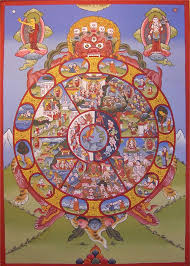
Spiral conditionality - the path leading to Nirvana - the Four Noble truths and the Noble Eightfold Path.

